Guide · PMS vs channel manager
PMS vs channel manager: what is the difference?
Two pieces of hotel software that are often sold separately: what each one does, job by job, when you need both, and what goes wrong when they are two systems.
The difference, in one line
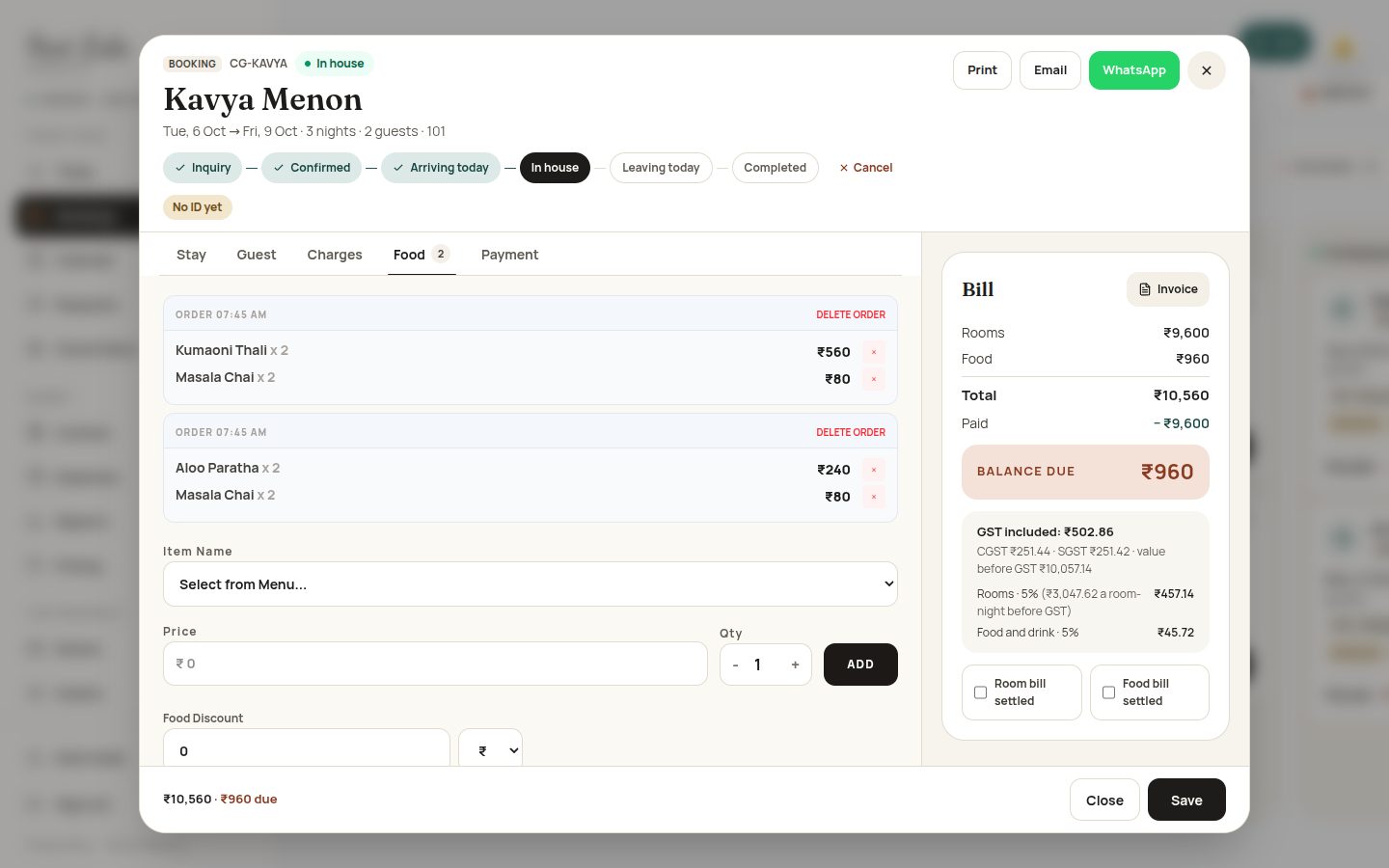
A PMS (property management system) runs the property: bookings, rooms, guests, bills, payments and reports. A channel manager connects the property to the OTAs: it brings in their reservations and sends out rooms available and rates. A PMS is where the work happens; a channel manager is how the OTAs hear about it.
Job by job: which one does what
The channel manager handles everything between you and the OTAs; the PMS handles everything between you and the guest.
| The job | PMS | Channel manager |
|---|---|---|
| Bring in OTA reservations, changes and cancellations | Records them on the calendar | Fetches them from each OTA |
| Send rooms available to every OTA | Works out what is free | Sends it to each OTA |
| Send rates and close dates | Where you set them | Sends them to each OTA |
| Assign rooms, check guests in and out | Yes | No |
| Direct, phone and walk-in bookings | Yes | No |
| The guest's bill, food and extras | Yes | No |
| UPI payments and what is still owed | Yes | No |
| GST invoices | Yes | No |
| Staff logins and roles | Yes | Only for its own settings |
| Reports: occupancy, revenue, profit | Yes | Channel figures only |
Do you need both?
If you sell on more than one website, you need what both do: something has to run the property, and something has to keep every OTA's availability matched to it. If you sell on a single OTA and nowhere else, its extranet and a register can be enough, until the second channel arrives.
Double bookings come from the gap between channels: the last room is sold on two sites before either hears about the other. The fix is one availability count that every channel is fed from, after every change. That is the channel manager's job, and it can only be as right as the calendar it reads.
When the PMS and the channel manager are two systems
Two systems means two calendars to keep matched, a mapping between them, two bills and two logins, and a question every time they disagree: which one is right?
- A booking taken at the desk has to reach the channel manager before an OTA sells the same room
- Room types and rate plans are mapped twice: OTA to channel manager, channel manager to PMS
- A change made in one, such as a closed date or a new rate, has to be made in the other too
- When something goes wrong, each company points at the other
- Two subscriptions, often from two companies
And the booking engine?
A booking engine is the third piece: the booking form on your own website, so direct guests book without OTA commission. It reads the same availability as the channel manager, so it belongs on the same calendar.
One system: Host Labs PMS
Host Labs PMS is a PMS with its own channel manager and booking engine built in: one calendar, one availability count for every OTA and your website, one login and one subscription, ₹1,800 a month per property billed yearly, plus GST, after 14 days free.
Already use a channel manager and want to keep it? We help you connect it to Host Labs PMS instead.
Questions
Is a channel manager part of a PMS?
Sometimes. Many PMS products sell the channel manager as a separate subscription, often from another company. Host Labs PMS has its own built in.
Can I use a channel manager without a PMS?
Yes, and some properties do: the OTAs stay in sync, but rooms, bills, payments and GST invoices are then kept somewhere else, often a register or a spreadsheet.
Is a channel manager the same as a booking engine?
No. A channel manager talks to the OTAs; a booking engine is the booking form on your own website. Both should read the same calendar.
What is the difference between a PMS and an OTA extranet?
An extranet is one OTA's back office, for that OTA only. A PMS holds every booking from every channel, and with a channel manager it updates every extranet for you.
Which is better for a small homestay?
One system that does both, so there is one calendar and nothing to keep matched. Host Labs PMS was built at a working homestay for exactly that.
Read next
- Channel manager: How a channel manager keeps Booking.com, Airbnb, MakeMyTrip, Agoda and your own website in sync, and why Host Labs PMS has one built in to stop double bookings.
- What is a PMS system: A PMS system (property management system) runs a hotel or homestay: bookings, rooms, guests, bills, OTAs and GST in one place. What it does, what it costs in India, and how to choose one.
- Booking.com channel manager: Booking.com and your PMS on one calendar: bookings arrive with a room, rooms and rates go back after each change, and each payout shows commission and taxes.
- Pricing: Core: the PMS and channel manager in one subscription, with the booking engine and guest app, from ₹1,800 a month per property + GST. Plus adds AI and 500 credits a month from ₹3,499. 14 days free.